

Welcome or welcome back!
In today’s newsletter, we get into a gory gothic novel, merry monsters, wellness scammers, and one of my all-time favorite drag queens.
You can say a lot of things about me, but you can’t say I don’t have range.
A Vicious Look Into a Victorian Era Psychopath

In the mood for a deliciously macabre holiday gothic? Well, eat up and enjoy the feast, my friend.
Virginia Feito’s Victorian Psycho pulls no punches in the three months leading up to Christmas at a Victorian manor. Readers are immediately transported into Winifred Notty’s world as she embarks on her new job as governess at the one and only Ensor House.
She’s out for blood—but you’ll quickly find that she’s the kind of antihero you hate to love. The more I learned about the inhabitants at the manor, the more I started to shrug and think… maybe I kind of get it. The Pounds family isn’t exactly the most likable.
There’s the perverted and pompous Mr. Pounds, his insecure and obsessive wife Mrs. Pounds, and their two snotty, spoiled children. It’s the perfect setting for rage and tension to build until the novel’s gruesome ending takes place against a cheery Christmas backdrop.
“In the dank dead of night, I haunt Ensor house. Tracing the unicorn horns on the tapestries with my fingertips, tongue-kissing the portraits of Lord Manlow, of Lady Augusta. Ensor house haunts me — the wallpapers bulging with hands, the mirrors reflecting back shadows of past maids.”
Aside from the gore (and trust me, there’s a lot of it as the novel progress), it’s a wickedly witty view into just how perverse the Victorian era was once you look past its constant moral posturing.
Winifred’s unapologetic thoughts cut deep throughout Victorian Psycho. And honestly, it was a nice change of pace to hear her murderous perspective instead of some dude’s. The boys have enough blood on their hands in media and literature already.
This book definitely isn’t everyone’s cup of tea. It’s unlike anything I’ve read. That being said, if you love the Victorian era, unhinged women, and extremely dark humor, it might just be one of your new favorites.
Consider yourself warned!
By the way… I also posted a video about the book on Instagram. Feel free to check it out here.
Thanks for reading along! Viewing this newsletter online or had it forwarded to you? Subscribe to get a fresh edition in your inbox every Wednesday.
The Creepy Origins of Christmas
When you really break it down, the modern version of Christmas is scary enough as it is. We’re out here telling children that a stranger is descending into their homes in the dead of night via chimney to deliver gifts—but only if they’ve been “good.” Whatever that means.
There’s also the late-stage capitalist hellscape of unbridled consumerism looming in the background at all times throughout the holiday season, but I digress.
I recently watched Kaz Rowe’s video “The Creepy History of Europe’s Christmas Folk Villains” and learned a ton about the origins of the creepy characters who exist in ancient lore. Oh, and the fact that the season initially began as an excuse to be chaotic and get totally sloshed.
I also found it fascinating that the Christmas of the past was actually much more similar to Halloween, with people using the time to play pranks on one another, dress up as monsters, and tell ghost stories. It makes a lot of sense when you remember that the Christmas season coincides with the darkest time of the year.
You’ll have to watch the video to get a deep dive of the lore, but below are some of my faves. You can’t go wrong with a classic Krampus moment. Or with Mari Lwyd, a character I hadn’t heard of until this video.
Long story short, she’s a decorated horse skull that goes around challenging Welsh townsfolk to contests and demanding food and drink. As random as the tradition may sound, she represents fertility and blessings in the dark winter season.
And hey, we could all use some extra levity this time of year!

Mari Lwyd being the creepy queen that she is around town.

Kinky Krampus? Alright then.
The Grand Rising of Spiritual Scammers
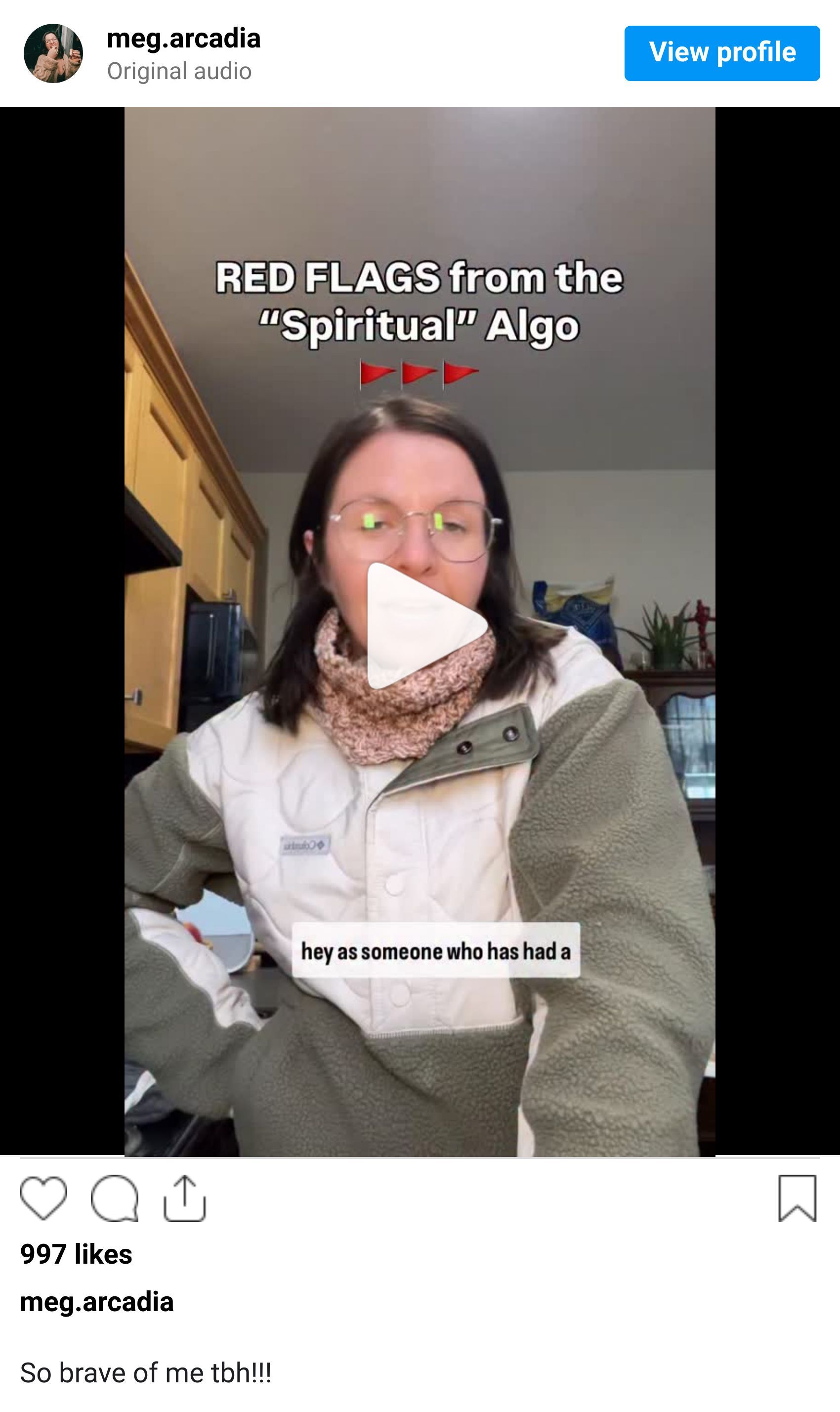
I’ve been deep in research mode for my spooky novel, and it’s sent me down a bunch of rabbit holes into LA’s extensive haunted history and the numerous cults that have called the City of Angels home.
The more I learn, it’s almost like sunny weather + the entertainment industry = the perfect formula for things to get very woo woo and very weird. It led me to an interesting thought experiment: what would the spiritual charlatans of decades past be doing if they had access to social media?
And that’s when it hit me. They’d totally be spiritual wellness grifters on platforms like Instagram and TikTok! Soon after, I came across the video above by Megan McDermott, aka @meg.arcadia, and she does an excellent job of breaking down these grifter types, the red flags to look out for, and the dangerous rhetoric they preach.
I also found out she has a newsletter called Signs of Life, which she describes as “Where ritual meets the real world. Ancestrally witchy guide decolonizing wellness & spirituality, breaking down politics, media & culture.”
Trust me, I’m one of the most woo woo people I know, and even I believe there’s a way to balance spirituality while still staying rooted in the real world. Nuanced creators like Megan truly get it and are a breath of fresh air!
Weird Girl of the Week: Divine

I still vividly remember my first encounter with Divine. I was a teenager in my bedroom, and my best friend and I decided to watch Pink Flamingos on my laptop after seeing artsy stills of the movie on tumblr.
It was my first exposure to drag queens, and to the John Waters universe as a whole. Divine announced herself in pure fabulosity and depravity. I was never the same since.
There was something so liberating about seeing her on screen and being absolutely unhinged, yet totally unashamed.
That’s the beauty of drag, after all. To be an outsider and spin it to the extreme, to a point of otherworldliness. It’s a brave and playful act of rebellion—a joyous, decadent defiance.
“All my life I wanted to look like Elizabeth Taylor. Now Elizabeth Taylor looks like me.”
Around that time, the documentary I Am Divine was released, which looked back on her life, career, and journey to becoming a queer cultural icon. Finding out about her music career uncovered a bunch of other hidden gems. I particularly loved the catchy lyrics and sassy 80s vibes in “You Think You’re A Man.”
“Divine. That's my name. It's the name John [John Waters] gave me. I like it. That's what everybody calls me now, even my close friends. Not many of them call me Glenn at all anymore, which I don't mind. They can call me whatever they want. They call me fatso, and they call me asshole, and I don't care. You always change your name when you're in the show business. Divine has stuck as my name. Did you ever look it up in the dictionary? I won't even go into it. It's unbelievable.”
The photo above is from a series of infamous Christmas cards by none other than John Waters. Highly recommend you check them out, but be warned that some definitely veer into NSFW territory (and I have no clue where you’re reading this right now).
Finally, I’ll leave you with this photo I took at the Academy museum during last year’s John Waters: Pope of Trash exhibit. Seeing actual costumes, set decoration, props, handwritten scripts, etc. from the films was such a treat.
I’m sure tacky teenage me would approve.

A full circle moment.
Welcome to the end. That sounds ominous… I meant the end of the newsletter.
If you just can’t bear for it to be over, don’t worry.
Follow me over on Instagram for more.
The Weird Girl Edit is a weekly newsletter written by Maya Rector, and it gets published every Wednesday. View past editions here. If you haven’t already, subscribe for the latest wacky musings in literature, media, and pop culture each week!